Can Your Landlord Put Cameras Up? Where the Line Falls in India
Published by BugSweepingTSCM · Published:
Most arguments about landlord cameras start with who owns the property, which is the wrong question. What decides it is what falls inside the frame, and an Indian High Court has just said so in terms.
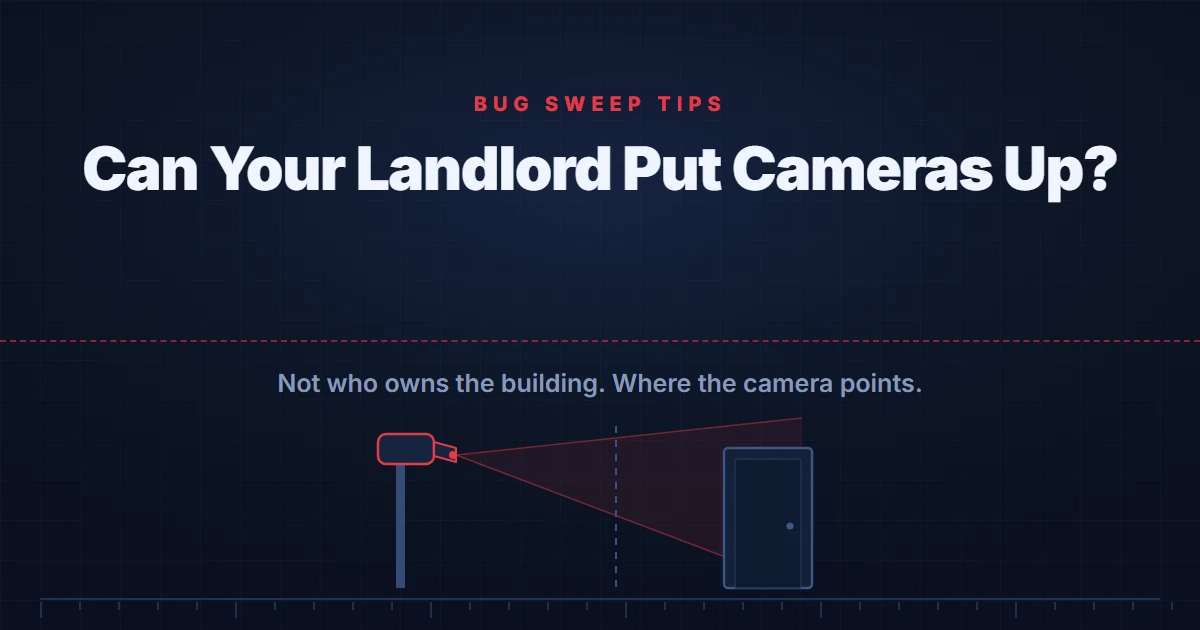
Short answer: Owning the building does not settle it. What settles it is where the camera points. A camera covering a shared entrance is an ordinary security measure; one covering a bedroom, bathroom or changing area is a criminal matter; and on 2 November 2026 the Allahabad High Court held that no private camera may be positioned so as to interfere with a neighbour's privacy.
Almost every argument about this starts in the wrong place. The landlord says it is their property. The tenant says it is their home. Both are true, and neither decides anything, because the law here is not organised around who holds the title deed.
It is organised around what falls inside the frame. A single camera, bolted to the same wall by the same person, can be unremarkable or criminal depending on which way it is turned. Once you see that, the question stops being a standoff about ownership and becomes something you can actually investigate and act on.
This page is about a camera you can see, or have been told about, and want to know your position on. A camera nobody mentioned is a different problem with a different answer, and our guide to hidden cameras in hotels and paying guest accommodation deals with that case, including what the Indian record shows about who actually places them.
What an Indian court said this month
The clearest recent statement on this is only days old, and it concerns a neighbour rather than a landlord, which makes it more useful rather than less, because the principle it states is about position rather than about the relationship between the parties.
On 2 November 2026 LiveLaw reported that the Allahabad High Court, on a petition by Yogendra Maurya, whose neighbour's CCTV camera covered the entry and exit points of his house, held that "no private CCTV camera can be installed and positioned in such a manner as to interfere with the privacy of a neighbour". The bench was Justice Ajit Kumar and Justice Garima Prashad.
Read the remedy as carefully as the holding, because it is the part you can use. The court did not order the camera removed or repositioned. It disposed of the writ petition and directed the petitioner to apply to the District Magistrate, and said that if he does, the District Magistrate must decide the application within one month.
That is a practical route most people do not know exists. The instinct in these disputes is to argue with the neighbour, complain to the society, or do nothing. A time-bound application to the District Magistrate is a fourth option, and a court has now pointed to it.
Where the line actually falls
The useful way to think about this is not a list of permitted places but a single question asked of each camera: what is inside its field of view, and does any part of that view belong to somebody's private life?
A camera covering a shared entrance, a lift, a staircase or a corridor is an ordinary security measure, and buildings everywhere have them. A camera covering a bathroom, a bedroom or a changing area is not a tenancy dispute at all; it falls squarely within the criminal provisions on voyeurism and on capturing images in circumstances that violate privacy, which our guide to detecting hidden cameras sets out in full with their separate penalty ranges.
Between those two lies the ground where most real disagreements sit, and it is worth naming the cases precisely.
- A camera at a shared entrance that also sees inside your doorway when the door opens. It was installed as an entrance camera and is described as one. In substance it covers part of your home every time you come and go.
- A camera angled at a window or a balcony. The camera may sit entirely on the landlord's or neighbour's property and still have your private space in its frame, which is exactly the situation the Allahabad High Court was considering.
- A camera covering the only approach to your door, recording who visits you and at what hour. Nothing private is captured inside, and a complete record of your associations is captured outside.
None of these is settled by asking who paid for the camera. All of them are approached by establishing, concretely, what the lens can see.
Told about it, or not told about it
There is a second distinction that changes the character of the problem, and it is about disclosure rather than position.
A camera you were shown when you took the flat, or that is plainly visible at the entrance, is something you can raise, negotiate and if necessary escalate. You know it exists, you can establish what it covers, and the dispute is about where it points.
A camera you were not told about is a different thing entirely, whatever it covers. Concealment is itself a fact about intent, and it moves the matter away from a disagreement between a landlord and a tenant. The Indian cases that reach the courts are overwhelmingly of this second kind, and they are usually found in shared washrooms rather than bedrooms.
India has no statute written specifically for landlords and cameras, which is why this is answered through general privacy and criminal law and, now, through what courts say about where a private camera may point. The notice and consent machinery under the Digital Personal Data Protection Rules, 2025 commences in May 2027, so the separate question of what a landlord or a housing society must tell residents about cameras is not yet operating. How any of it applies to your own tenancy is a question for a lawyer rather than for a web page.
What to settle before you take the flat
Almost everything above is easier to resolve before you move in than afterwards, and the questions are short enough to ask at a viewing.
Ask what cameras exist on the property and where they point. Ask whether any of them cover the entrance to your unit, a balcony or a window. Ask who can see the recordings, which in a building with a society or a property manager is often a different answer from the landlord, and ask how long footage is kept. A landlord who answers those four questions readily is unlikely to be the problem; one who treats them as an accusation has told you something.
Then get what you were told into the agreement, or at least into a message you keep. The common pattern in disputes is not a landlord who lied at the start. It is a camera added quietly later, at which point a record of what was agreed when you took the flat is the most useful document you have.
If there is a camera you object to
Work in this order. It is built so that each step preserves your position for the next one.
- Establish what it covers, from where you stand rather than by handling it. Photograph its position and angle. If you can see the lens from your door, your window or your balcony, that is the fact that matters and it is worth recording with a date.
- Put it in writing to the landlord or the society, asking what the camera covers, who can view the recordings and how long they are kept. A dated written request creates a record and often resolves the matter.
- If it is not resolved, consider the District Magistrate, which is the route the Allahabad High Court pointed to, with the one month timeline it mentioned.
- If the camera covers a bathroom, bedroom or changing area, stop treating it as a dispute. That is a police matter. Cybercrime complaints, including the publication of private images, can be filed at cybercrime.gov.in, which routes to the relevant state police, and in immediate danger call 112.
- Do not remove, cover or disable it first. It destroys the evidence of what it was and where it pointed, and it hands the other side an argument about your conduct instead of theirs.
What a check can and cannot establish
A physical examination reports what was found in the areas accessed, by the methods used, under the conditions present, at the time of the visit. It can report what was physically found and what was transmitting in the bands examined while the examiner was present. It cannot establish that a device recording to internal memory is absent, because such a device emits nothing at all.
For a camera you can already see, an examination is usually the wrong instrument, and it is worth saying so plainly. You do not need anybody to find it. What you need is a clear account of what it covers and a route to act, which is a legal and evidential question rather than a technical one.
Where an examination earns its place is the other case: you have reason to believe there is something you have not been shown. Our national guide to bug sweeping sets out what that covers, and our guide to finding a listening device explains the physical constraints that decide where a concealed device can be at all.
Frequently asked questions
Can my landlord put cameras inside the house I rent?
Inside the part of the premises you occupy, a camera is in the space the tenancy gives you, and in a bathroom, bedroom or changing area it moves out of the realm of house rules entirely and into the voyeurism and privacy provisions of criminal law. Ownership of the building does not create a right to watch the inside of a home somebody else is living in. A camera in a genuinely common entrance is a different question from a camera in a living room, and the two should never be argued as one thing.
Can my landlord or neighbour point a camera at my door?
An Indian court has now said no in terms. On 2 November 2026 LiveLaw reported that the Allahabad High Court, hearing a petition by a man whose neighbour's camera covered the entry and exit points of his house, held that no private CCTV camera can be installed and positioned in such a manner as to interfere with the privacy of a neighbour. The court did not order the camera moved. It disposed of the petition and directed the petitioner to apply to the District Magistrate, who must decide within one month.
What should I do about a camera I object to?
Start by establishing what it actually covers, because that is the question everything else turns on, and photograph its position from where you stand rather than handling it. Raise it in writing with the landlord or the society so there is a record and a dated request. The Allahabad High Court's route in the neighbour case was an application to the District Magistrate. If the camera covers a bathroom, bedroom or changing area, that is not a dispute to negotiate, it is a police matter.
Is a camera in the common entrance of my building allowed?
A camera covering a shared entrance, lift or corridor is an ordinary security measure and is treated very differently from one covering a private space. The line is not the building, it is what falls inside the frame. A camera at an entrance that also covers the inside of a doorway, or that is angled to see into a window or a balcony, stops being an entrance camera in substance whatever it is called.
Does India have a law about landlords and CCTV specifically?
No dedicated statute governs it, which is why the question is answered through general privacy and criminal provisions and, now, through what courts say about where a private camera may point. The notice and consent machinery under the Digital Personal Data Protection Rules, 2025 commences in May 2027, so the separate question of what a landlord or a housing society must tell residents about cameras is not yet operating. How any of this applies to your tenancy is a question for a lawyer.
Can I remove or cover a camera I think is unlawful?
Removing or disabling something is rarely the right first move, because it destroys the evidence of what it was and where it pointed, and it can turn your complaint into a dispute about your own conduct. Record what exists, raise it in writing, and take the route that fits: the landlord or society for a camera in a shared area, the police for one covering a private space. Our guide to hidden cameras in hotels and paying guest accommodation covers the case where the camera was never disclosed at all.
Not sure whether there is a camera you have not been told about?
A camera you can see is a question about where it points. A camera nobody mentioned is a different problem, and a physical examination can address it. A private consultation can help you decide whether one is warranted.
Request a consultation on WhatsApp