Is Your Phone Tapped? What Indian Law Actually Allows
Published by BugSweepingTSCM · Published:
There is no code to dial and no symptom to look for, because a lawful tap never touches your handset. The Rules that govern it are specific about who may authorise one, for how long, and what happens to the recordings.
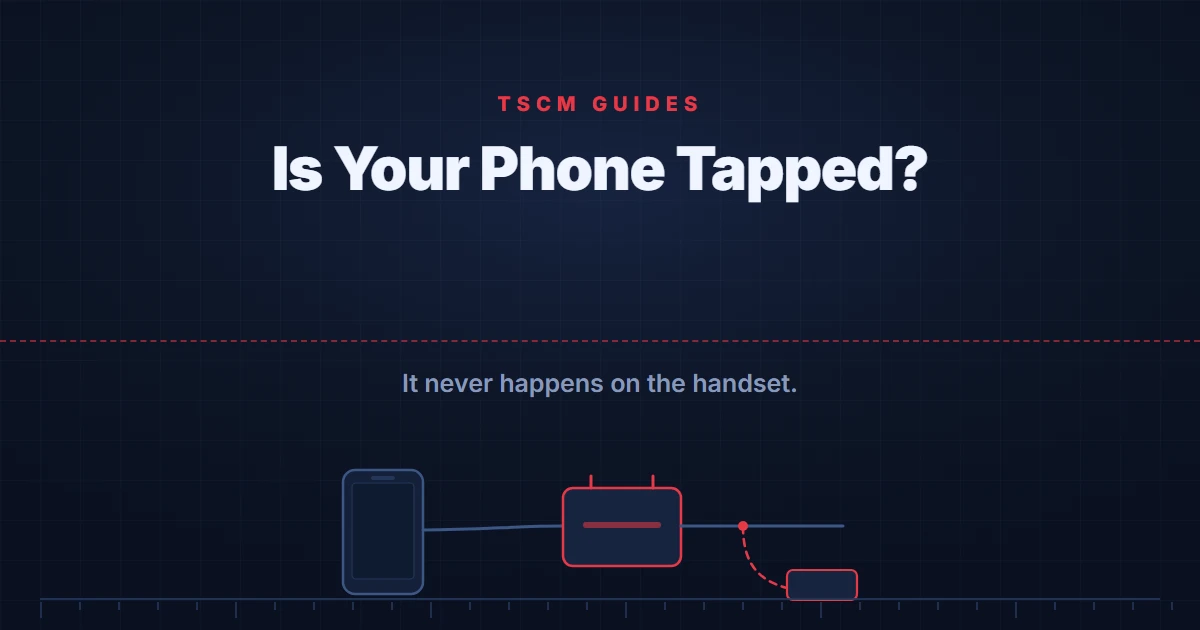
Short answer: You cannot tell from the handset, because a lawful tap in India does not happen on the handset. It happens at the telecom operator, under an order that only the Union Home Secretary or a State Home Secretary can sign, lasts at most 180 days in total, and is reviewed by a committee chaired by the Cabinet Secretary.
This question is asked constantly and answered badly almost everywhere, because most of the answers describe things you could notice on your phone. Clicks on the line. A battery running hot. A code to dial. None of that is evidence of interception, and the reason is structural rather than technical.
A lawful interception is carried out by the telecommunication entity that carries your calls and messages. Your handset is not modified, not contacted and not involved. There is nothing on it to find, which means no app, no code and no symptom can tell you about it. That is worth knowing before anyone sells you a detection service for it.
What you can know is the framework, and in India it is unusually specific. Section 20 of the Telecommunications Act, 2023 provides the power, and the Telecommunications (Procedures and Safeguards for Lawful Interception of Messages) Rules, 2024 set out the procedure. The rest of this page is what those Rules actually say.
Who can authorise it
Not a police officer, and not a telecom operator on request. The Rules name a competent authority, and it sits high.
For the Centre it is the Union Home Secretary in the Ministry of Home Affairs. For a State it is the Secretary to the State Government in charge of the Home Department. That is the signature an interception order requires, and the seniority is the point: the framework is designed so that this is a political and administrative decision taken at the top of a ministry, with a name attached to it.
The Rules do provide for urgent situations, but the structure above is the ordinary route, and everything that follows exists to check it.
How long it can last
This is the provision most worth knowing, and it is a ceiling rather than a discretion.
An interception order remains in force, unless revoked earlier, for a period not exceeding sixty days from the date specified in it. It may be renewed. But the Rules set an outer limit on the whole exercise: no such order may remain in force beyond a total of 180 days.
So lawful interception in India is time-bound by design. It is not a tap that is attached and forgotten. Somebody has to decide, at sixty day intervals, that it is still justified, and after six months the authority ends regardless.
Who checks that it was lawful
The Rules build in a review mechanism with named office-holders, fixed deadlines and a power to undo what was done.
- Every order goes to a review committee within seven working days of being issued or confirmed.
- At the Centre that committee is chaired by the Cabinet Secretary, sitting with the Secretary of the Department of Legal Affairs and the Secretary of the Department of Telecommunications.
- In a State it is chaired by the Chief Secretary, with the Law Secretary or Legal Remembrancer and a Secretary other than the Home Secretary.
- The committee meets every two months.
- If it finds an order does not comply with section 20, it may set aside that order and direct the destruction of the copies of the intercepted messages.
That last power is the one that gives the rest its force. A review that could only record disapproval would be a formality. A review that can order the material destroyed is a check.
What happens to the recordings
The Rules do not leave retention open-ended, and the timetables differ by who is holding the material.
Records held by the authorised agency, the competent authority and the review committee are to be destroyed every six months, unless those records are, or are likely to be, required for functional requirements or under directions of a court. The Department of Telecommunications and the telecommunication entities involved must destroy their records within two months of the interception order being discontinued.
Two months and six months are short periods, and they are the answer to the common assumption that once a tap exists the material exists forever.
Why none of this is detectable from your phone
Put the architecture and the law together and the conclusion is unavoidable, which is why it is worth stating plainly rather than leaving implied.
The interception happens on the operator's side of the connection. Nothing is installed on your device, so there is nothing for an app to detect, no process to find and no battery drain to notice. No dialled code reveals it, and codes like the ones people circulate report call forwarding settings, which is an unrelated feature. Our guide to the signs that an office is bugged deals with the clicks, static and other folklore in detail, including why they stopped meaning anything when networks went digital.
There is also a simple structural check on the fear. The framework above requires a Home Secretary's signature, a review by the Cabinet Secretary's committee and renewal every sixty days. It is not a resource that gets pointed at people casually.
The problem you probably do have
When somebody is genuinely listening to a person's conversations without authority, it is almost never through the network. It is through the device or the room, because those are reachable without a Home Secretary.
Software installed on the handset by somebody with physical access is the common case, and it leaves evidence on the device, which is why it can be investigated. Our guide to phone monitoring and stalkerware sets out what that evidence looks like and, importantly, why removing it first is usually the wrong move.
A device in a room is the other case, and it obeys physical constraints that narrow the search considerably, which our guide to finding a listening device works through. If the worry is a boardroom rather than a handset, our guide to corporate espionage in India sets out which layer the risk actually sits in.
What an examination can and cannot establish
A physical examination reports what was found in the areas accessed, by the methods used, under the conditions present, at the time of the visit. It can report what was physically found and what was transmitting in the bands examined while the examiner was present. It cannot establish that a device recording to internal memory is absent, because such a device emits nothing.
On the specific question this page is about, the limit is absolute rather than partial. No sweep of a room and no examination of a handset can establish whether a lawful interception order exists at your operator, because the activity leaves no trace on your side of the network at all. Anyone offering to determine that for you is selling something that cannot be done. Our national guide to bug sweeping sets out what an examination does cover, and this is firmly outside it.
Frequently asked questions
How can I tell if my phone is tapped?
Not from the handset, and that is the honest answer nobody sells. A lawful interception in India happens at the telecom operator, not on your device, so there is nothing on the phone to find and no code to dial that reveals it. Unlawful interception of your conversations almost always means software installed on the device instead, which is a different problem with different evidence. The folklore signs, clicks, static, a warm battery, were debunked decades ago.
Who can authorise a phone tap in India?
Under the Telecommunications (Procedures and Safeguards for Lawful Interception of Messages) Rules, 2024, the competent authority is the Union Home Secretary for the Centre and the Secretary in charge of the Home Department for a State. It is not a police officer's decision, not a court order in the ordinary sense, and not something a telecom operator can do on request.
How long can an interception order last?
Each order stays in force, unless revoked earlier, for a period not exceeding sixty days, and it can be renewed. The Rules set an outer limit: no order may remain in force beyond a total of 180 days. That ceiling is one of the most useful things to know, because it means lawful interception is time-bound by design rather than open-ended.
Is anyone checking that these orders are lawful?
Yes, and the machinery is specified. Every order must go to a review committee within seven working days. At the Centre that committee is chaired by the Cabinet Secretary with the Secretaries of Legal Affairs and Telecommunications; in a State it is chaired by the Chief Secretary. The committee meets every two months, and if it finds an order does not comply with section 20 it may set aside the order and direct destruction of the copies of the intercepted messages.
What happens to the recordings afterwards?
The Rules impose destruction timetables rather than leaving it open. Records held by the authorised agency, the competent authority and the review committee are to be destroyed every six months, unless they are or are likely to be required for functional requirements or under court directions. The Department of Telecommunications and the telecom entities involved must destroy their records within two months of the interception order being discontinued.
Does *#21# or any similar code show whether my phone is tapped?
No. Those codes report call forwarding settings, which is a different thing entirely and tells you nothing about interception. Our guide to the signs an office is bugged takes that particular myth apart along with the clicks and static that people have reported for decades.
Worried about a device rather than a warrant?
Unlawful listening usually means something in a room or on a device rather than an order served on an operator. A private consultation can help you work out which problem you have and whether a physical examination is warranted.
Request a consultation on WhatsApp